
Foam Support Factor (SAG Factor): What the 65/25 IFD Ratio Means

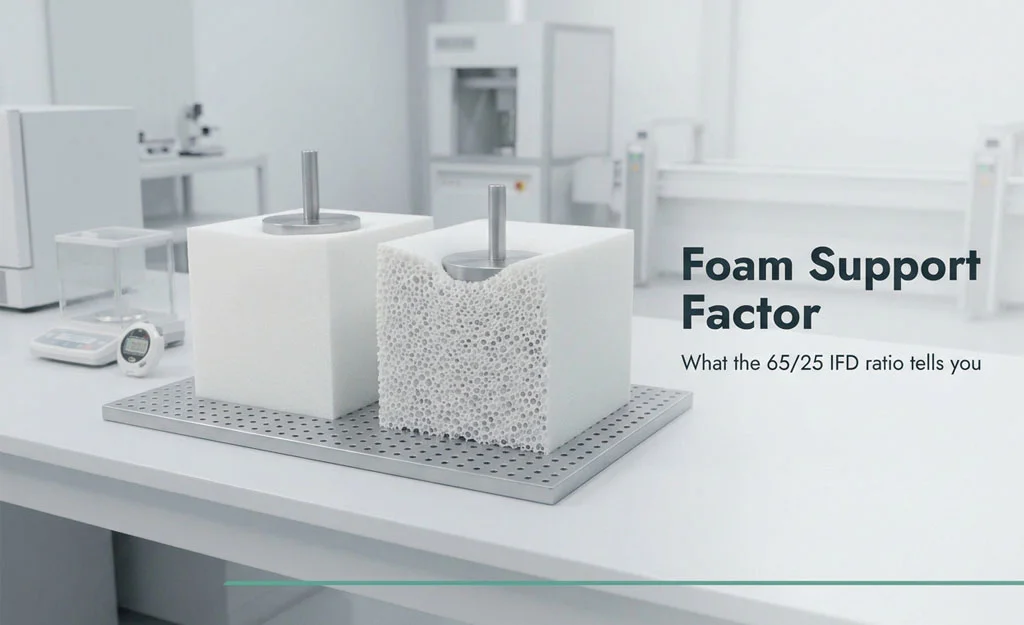
Two foams can have the same 25% IFD and still feel completely different once someone sits down. One sinks in gently and then holds; the other keeps giving way. The number that captures this difference is the support factor, also called the SAG factor or compression modulus. This article explains how the foam support factor is calculated, what the result tells you and where it can mislead. For the full set of foam tests, see our foam testing guide.
What is the foam support factor?
The support factor is the ratio of the force needed to indent a foam to 65% of its thickness to the force needed to indent it to 25%. ASTM D3574 defines it directly as the 65% IFD value divided by the 25% IFD value.
The 25% reading describes how the surface feels when you first sit or lie down. The 65% reading describes how the foam behaves deeper in, where it carries most of the body weight. Dividing one by the other shows how quickly the foam firms up as it is compressed. A foam that firms up steeply supports the body well without feeling hard on the surface; a foam with a low ratio tends to let the body sink through to the base. How the 25% IFD itself is measured and read is explained in IFD vs ILD.
How to calculate the support factor
Both values come from the same indentation test on the same specimen, so no extra test is needed. In ASTM D3574 Test B1, a 323 cm² (Ø203 mm) indentor presses into the specimen and the force is read at 25% and 65% indentation. Take a simple example: if a foam reads 120 N at 25% and 252 N at 65%, its support factor is 252 ÷ 120 = 2.1.
Because the result is a ratio, it has no unit. That also makes it easier to compare between specifications written in pounds-force and in newtons, as long as both readings come from the same method.
Support factor in ASTM D3574 and ISO 2439
| ASTM D3574 Test B1 | ISO 2439 method E | |
|---|---|---|
| Name of the result | Support factor | Compression factor (Sf) |
| Calculation | 65% IFD ÷ 25% IFD | Force at 65% ÷ force at 25% |
| Minimum specimen | 380 × 380 × 100 mm | 380 × 380 × 50 mm |
| Other results from the same test | 25% and 65% IFD values | Hysteresis loss from the loading and unloading curve |
The principle is the same, but specimen thickness and the test sequence differ, so a support factor from one method shouldn’t be compared directly with a compression factor from the other. How the ASTM and ISO methods map to each other is covered in ASTM D3574 vs ISO.
What a high or low support factor means
The Polyurethane Foam Association puts the typical range for flexible foam at about 1.5 to 2.6, with higher numbers meaning better support. In practice the result is read like this:
- Low ratio: the foam stays soft deep into compression. It can feel comfortable at first, but heavier users may bottom out.
- Middle of the range: a balance between a soft surface and support deeper in.
- High ratio: the foam firms up strongly as it is compressed. High resilience (HR) foams generally sit toward this end, which is why they are used for seating that has to feel soft and still hold the body.
There’s no single correct value. A comfort layer in a mattress and a car seat cushion need different ratios, so the target belongs in the product specification.
What affects the support factor?
The support factor depends mainly on cell structure and polymer chemistry, not just on density. Two foams of the same density can give different ratios if one has a more open, irregular cell structure. Formulation, the type of polyol, and how the foam is made all play a part. Density still matters, because it influences how much material resists deep compression, but it doesn’t decide the result on its own. How density, hardness and resilience relate in practice is explained in foam density vs hardness vs resilience.
The support factor and ball rebound resilience are often read together. Resilience describes how much energy the foam gives back; support factor describes how its resistance grows under load. A foam can score well on one and poorly on the other, so a good specification lists both. Resilience is covered in what is foam resilience.
Where support factor results can mislead
Different specimen thickness: a ratio measured on a 50 mm specimen isn’t directly comparable with one from a 100 mm specimen. Always report the thickness.
Different methods: ASTM B1 and ISO 2439 use different preflex cycles and hold times. The report should name the method.
Conditioning: foam tested too soon after production or outside the standard atmosphere gives unreliable IFD values, and the ratio inherits the error.
Reading the ratio alone: two foams with a support factor of 2.0 can still differ widely in firmness. The ratio should always be quoted together with the 25% IFD value.
Frequently asked questions
Is support factor the same as SAG factor?
Yes. Support factor, SAG factor and compression modulus all refer to the ratio of the 65% IFD value to the 25% IFD value.
What is a good support factor for mattress foam?
It depends on the layer and the intended feel. Typical flexible foams fall between about 1.5 and 2.6, and higher values mean better support. The target value should be agreed in the specification.
Does higher density mean a higher support factor?
Not necessarily. Density has an influence, but cell structure and formulation often matter more. Two foams of the same density can have different support factors.