
Foam Compression Set Test: ISO 1856 and ASTM D3574 Test D

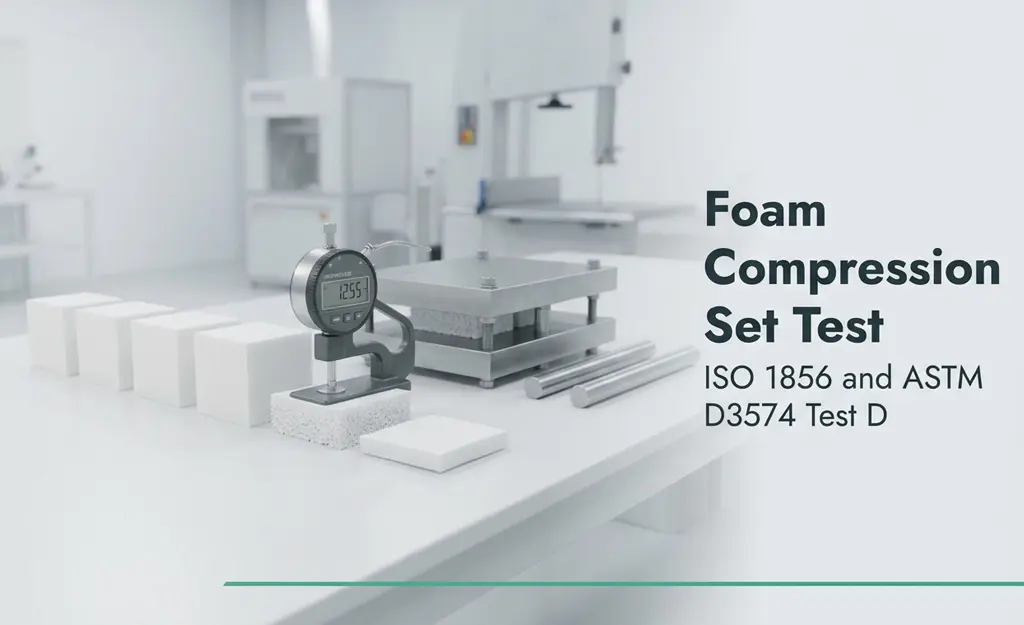
A mattress that develops a dip after a few months, or a seat cushion that stays flattened where people sit, usually has a compression set problem. When foam stays under load for a long time, it doesn’t fully return to its original thickness, and the difference is measured as permanent deformation. This article explains how a foam compression set test is run to ISO 1856, how the result is calculated and how it differs from ASTM D3574 Test D. For the full set of foam tests, see our foam testing guide.
What is compression set in foam?
Compression set is the thickness a foam fails to recover after it has been compressed by a set amount, held at a set temperature for a set time, and then released. ISO 1856 expresses that loss as a percentage of the original thickness. If a 25 mm specimen comes back to 24 mm after the test, its compression set is 4%.
The number gives an early view of how much a foam will settle over its service life. It shows up in customer specifications for mattresses, furniture, car seats and packaging foam. It’s also a quick signal of formulation problems: a foam with an unbalanced catalyst package or an incomplete cure typically shows a clearly higher compression set.
Compression set is a static test. The foam is held under one compression without repeated loading, so it complements hardness and fatigue tests rather than replacing them.
How the ISO 1856 compression set test works
ISO 1856:2018 covers compression set of flexible cellular polymeric materials. It describes three methods: compression at 70 °C (Method A), compression at the standard conditioning temperature (Method B), and compression under conditions agreed between the parties (Method C). The standard notes that the three methods can give different results, so the report must always name the method.
Specimens and conditioning
The test typically uses five specimens of 50 × 50 × 25 mm. They’re cut without crushing the cells, with parallel faces and the mold skin removed. After the minimum age after production, specimens are conditioned at 23 ± 2 °C and 50 ± 5% relative humidity, or at 27 ± 2 °C and 65 ± 5% relative humidity. Thickness is measured to ISO 1923. Waiting times and cutting rules are covered in detail in our guide to foam sample preparation.
Compression, temperature and time
In Method A, the most common one, the specimen is compressed between two flat plates with spacers to 50% or 75% of its thickness. In special cases the parties can agree on 90%. Within 15 minutes the compressed assembly goes into an oven at 70 ± 1 °C for 22 hours. It’s then taken out of the device, left to recover in the standard atmosphere, and its final thickness is measured.
Method B follows the same logic at room temperature and shows how the foam behaves without the effect of heat. Method C is left open for conditions that match the end use, such as a different temperature or duration.
Calculating the result
ISO 1856 calculates compression set as:
Compression set (%) = (d₀ − dᵣ) / d₀ × 100
Here d₀ is the original thickness and dᵣ is the thickness after the recovery period. The report gives each specimen’s result and the combined value for the five specimens as the standard specifies. For example, a specimen measured at 25.0 mm before and 23.5 mm after recovery gives (25.0 − 23.5) / 25.0 × 100 = 6%.
ISO 1856 vs ASTM D3574 Test D
ASTM D3574 covers the same property under Test D, constant deflection compression set. The principle is the same, but the calculation and some conditions differ:
| ISO 1856 (Method A) | ASTM D3574 Test D | |
|---|---|---|
| Specimen size | 50 × 50 × 25 mm | 50 × 50 × 25 mm |
| Compression | 50% or 75% (90% by agreement) | 50%, 75% or 90% |
| Temperature and time | 70 ± 1 °C, 22 hours | 70 ± 2 °C, 22 hours |
| How the result is expressed | Percentage of original thickness | Percentage of original thickness (Ct) or of the deflection applied (Cd) |
The calculation is where most confusion starts. ASTM’s Cd value divides the thickness loss by the deflection rather than by the original thickness, so on the same specimen it comes out higher than the ISO figure. Before comparing a supplier’s value with your own lab’s, ask which standard and which expression was used. Other ISO and ASTM test pairs are mapped in ASTM D3574 vs ISO.
What affects foam compression set?
Two foams made on the same line on the same day can still give different compression set results. The main factors are:
- Density: within the same formulation family, compression set generally falls as density rises. Low density foams have thinner cell walls and deform permanently more easily. How density is measured is explained in foam density test standards.
- Formulation and foam type: polyol type, isocyanate index and additives all affect the result. High resilience (HR) and viscoelastic foams behave differently from conventional foam under the same test conditions.
- Cure and aging time: a specimen whose reaction hasn’t finished gives a high compression set, which is why testing straight after production is misleading.
- Cell structure: in foam with a high closed cell content, gas escapes during compression and the foam recovers slowly, which raises the result.
- Humidity: specimens held in a humid environment can give different results from dry ones, so the conditioning atmosphere matters.
Compression set vs dynamic fatigue
Compression set and fatigue tests are often confused because both describe how foam settles over time. The difference is in the loading. In a compression set test the foam is held at one compression, statically and usually at high temperature. In a dynamic fatigue test to ISO 3385, the foam takes thousands of repeated loads that imitate sitting down and getting up, and the loss in thickness and hardness is measured afterwards.
A mattress foam can pass the compression set test and still lose much of its hardness in the fatigue test, or the other way round. That’s why products sold on durability are assessed with both tests. The fatigue procedure is explained in how to perform a foam fatigue test.
FAQ
What is a good compression set value for foam?
There’s no single correct value. The acceptable limit depends on foam type, density, end use and the compression used in the test, and it’s usually set in the customer specification. When comparing values, make sure the standard, method and compression are the same.
Why is the compression set test run at 70 °C?
Heat brings out in a short time the aging a foam would go through over long service. The 22 hour test shows a deformation tendency that would take much longer to appear at room temperature. If room temperature behavior is needed as well, ISO 1856 Method B is used.
Is compression set the same as hardness loss?
No. Compression set measures loss of thickness. Hardness loss comes from comparing hardness measured before and after a fatigue test. A foam can keep its thickness and still soften.