
Foam Testing Guide: Properties, Standards and Equipment

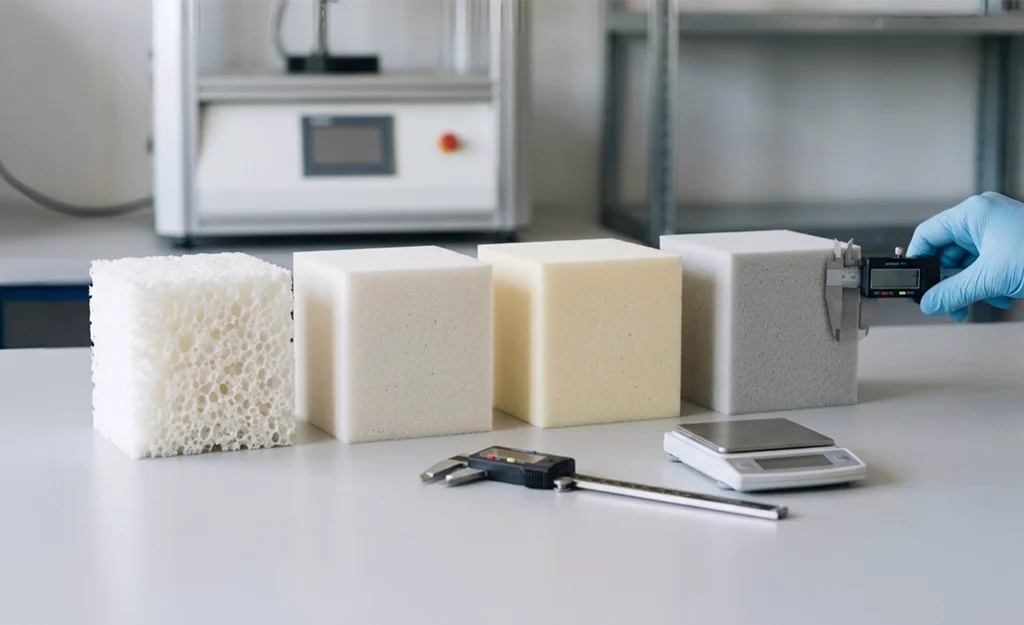
Two blocks of flexible polyurethane foam can look identical on the warehouse floor and behave completely differently a year later. One keeps supporting a mattress user night after night; the other sags into a permanent dip. You can’t see that difference, and you can’t feel it reliably with your hand. It only shows up when the foam’s properties are measured against recognized standards.
This guide covers what a foam producer’s lab actually measures, which ISO and ASTM methods apply to each property, and what equipment does the work.
Why foam testing matters on the production floor
Testing isn’t paperwork for a quality certificate. It’s a daily control tool, and it pays for itself in three ways:
- Consistency between batches. A small shift in isocyanate index, a change in catalyst level or a few degrees of ambient temperature will move density and hardness. Regular measurement catches the drift before a whole block goes out of spec.
- Proof of compliance. Automotive and bedding buyers specify values measured to a named standard. Without a test report, you can’t prove conformity, and you negotiate from a weaker position.
- Fewer returns and claims. A mattress that bottoms out after six months, or a seat that loses its support, usually traces back to a property nobody measured before shipment. Fixing that in the field always costs more than catching it in the lab.
In short, test data is the shared language between your production line and your sales team.
What gets measured: properties and standards at a glance
Most flexible foam labs work from the same six core properties. The ISO methods dominate in Europe, the Middle East and much of Asia, while North American buyers usually cite ASTM D3574, which groups most foam tests under a single standard with letter codes.
| Property | What it tells you | ISO method | ASTM D3574 | Unit |
|---|---|---|---|---|
| Density | Mass per volume; the baseline for almost every other result | ISO 845 | Test A | kg/m³ (lb/ft³) |
| Hardness (indentation force) | Force needed to compress the foam to a set percentage of its thickness | ISO 2439 | Test B1 | N (lbf) |
| Resilience (ball rebound) | How high a steel ball bounces back; the foam’s “liveliness” | ISO 8307 | Test H | % |
| Tensile strength and elongation | Resistance to tearing apart when pulled, and stretch at break | ISO 1798 | Test E | kPa and % |
| Compression set | Thickness the foam doesn’t recover after long compression | ISO 1856 | Test D | % |
| Dynamic fatigue | Loss of thickness and hardness after repeated loading | ISO 3385 | Test I3 | % |
None of these numbers stands alone. Comparing the hardness of two samples with different densities, for example, leads to the wrong conclusion. That’s why every test report should state density alongside the other results. For the full ASTM D3574 to ISO mapping, including which pairs are truly equivalent, see ASTM D3574 vs ISO.
Density: the number every other result depends on
Density comes first because it sets the ceiling for everything else the foam can do. It’s expressed in kg/m³, while US buyers often quote lb/ft³. The conversion is simple: 1 lb/ft³ equals about 16 kg/m³, so a 1.8 lb/ft³ foam is roughly 29 kg/m³.
There’s a distinction that trips up many supplier conversations. Free-rise density forms while the foam expands without restriction during the reaction, and it describes the formulation itself. Apparent density, on the other hand, is measured on the cut, finished product and can vary with mold pressure and with where in the block the sample came from. When a customer and a supplier disagree about density, they’re often quoting different ones.
Tracking rise height during foaming gives an early warning. A mixing ratio problem shows up in the rise profile before an entire block is poured. That’s the job of the MK-1020 Foam Height Measurement Tester. For measurement methods and standards in detail, see Foam density test standards.
Hardness and resilience are not the same thing
In everyday conversation, “firm foam” and “foam with no bounce” get used interchangeably. They’re two different properties, measured with two different tests. How density fits alongside them is covered in foam density vs hardness vs resilience.
Indentation force deflection (ISO 2439 / ASTM D3574 Test B1)
Hardness is the force needed to push a circular indentor into the sample to a set percentage of its thickness. ISO 2439 method A commonly reads the force at 40% indentation after a 30 second hold. ASTM D3574 Test B1, the familiar IFD in the US bedding trade, usually reports values at 25% and 65%, and the ratio between them gives the support factor. Because the result depends on indentation speed and hold time, two numbers only compare if they were measured the same way. For the full B1 procedure and how to read IFD values, see IFD vs ILD.
Ball rebound resilience (ISO 8307 / ASTM D3574 Test H)
The resilience test drops a steel ball onto the sample from a fixed height and records how high it bounces, as a percentage. A high value means a lively foam that recovers its shape quickly; a low value means a foam that absorbs energy. High resilience (HR) foam is prized in premium mattresses and seating, while viscoelastic and packaging foams target low rebound on purpose.
This measurement is made with the MK-1040 Foam Resilience Tester. The method is covered step by step in What is foam resilience (ball rebound) testing?
Tensile strength and elongation at break
Foam tears more often during manufacturing than in use: while it’s pulled off a line, stretched into a seat cover or stapled into upholstery. The tensile test shows how well it handles that stress.
The sample is die-cut into a dumbbell shape, with two wide ends held in the grips and a narrower middle section where the break happens. It’s pulled at constant speed until it fails, and two values are recorded: tensile strength in kPa and elongation at break as a percentage of the original length. Read them together. A foam with high strength but low elongation is brittle, and it will snap on an upholstery line.
The test follows ISO 1798 or ASTM D3574 Test E, using the MK-1070 Foam Tensile Tester.
Dynamic fatigue: predicting how foam ages
Everything above describes foam when it’s new. The complaints, however, arrive months later: the mattress develops a dip, the seat loses its support. Dynamic fatigue testing compresses that aging into a few days.
In ISO 3385, the sample’s thickness and hardness are measured first. It’s then pounded with a constant load 80,000 times at 70 ± 5 strokes per minute. After a recovery period, the measurements are repeated and the loss in thickness and loss in hardness are calculated as percentages. ASTM D3574 Test I3 describes a comparable constant force pounding method. Of all the lab results, this one comes closest to what the end user actually experiences.
The test is run on the MK-1090 Foam Fatigue Tester. For the full procedure, see How to perform a foam fatigue test.
Sample preparation for foam testing
Even the most precise instrument can’t rescue a badly prepared sample. Most standards agree on three basics.
First, give the foam time after production. Its properties keep changing for days after the reaction, and many methods call for at least 72 hours before testing. Second, condition the sample at 23 ± 2 °C and 50 ± 5% relative humidity, typically for 12 to 16 hours depending on the standard. Third, cut from the core of the block with clean edges and leave out the outer skin, which is denser than the core and skews the result upward.
During formulation work, meanwhile, trial batches are mixed in small quantities before anything goes to full production. The MK-1060 Foam Lab Mixer is built for that step. How those trial mixes turn into production foam is explained in how polyurethane foam is made.
Building an in-house foam testing program
You don’t need every test on day one. A practical sequence looks like this:
- Start from what your customers specify. Work from the properties named in buyer specifications, not from the full list of possible tests.
- Begin with density and hardness. Most day-to-day production drift shows up in these two values.
- Fix and document the method. A report that doesn’t state the standard and the conditioning won’t hold up in a negotiation.
- Keep the results over time. The real value lies in the trend across batches, not in any single reading.
- Expand step by step. Add tensile and fatigue testing as you move into markets that demand proof of durability.
Vilutra designs and builds its foam testing equipment in Türkiye and supports it from İzmir, with more than 20 years of experience automating foam production. That means calibration and service don’t depend on parts shipped from the other side of the world. Browse the full product range or get in touch to discuss what your lab needs.
Foam testing FAQ
How is foam density measured?
A cleanly cut sample is measured at several points to calculate its volume, then weighed on a precision scale. Dividing mass by volume gives density in kg/m³. The measurement should follow ISO 845 or ASTM D3574 Test A, on a conditioned sample with the skin removed.
What is the difference between density and IFD?
Density describes how much material the foam contains, while IFD describes how much force it takes to compress it. Two foams with the same density can have very different IFD values depending on the formulation. That’s why specifications list the two separately.
Is ASTM D3574 the same as ISO foam standards?
Not exactly. The two families measure the same properties on similar principles, but sample sizes, indentation levels and reporting details can differ. For instance, ISO 2439 commonly reports hardness at 40% indentation, while ASTM IFD is usually quoted at 25% and 65%. Always compare results measured to the same standard.
Should I test foam in-house or use a third-party lab?
A third-party lab works well for occasional certification. For daily production control, however, waiting days for a result means the bad batch has already shipped. Any plant producing on a regular schedule benefits from running at least density and hardness in-house.