
How Polyurethane Foam Is Made: Slabstock vs Molded

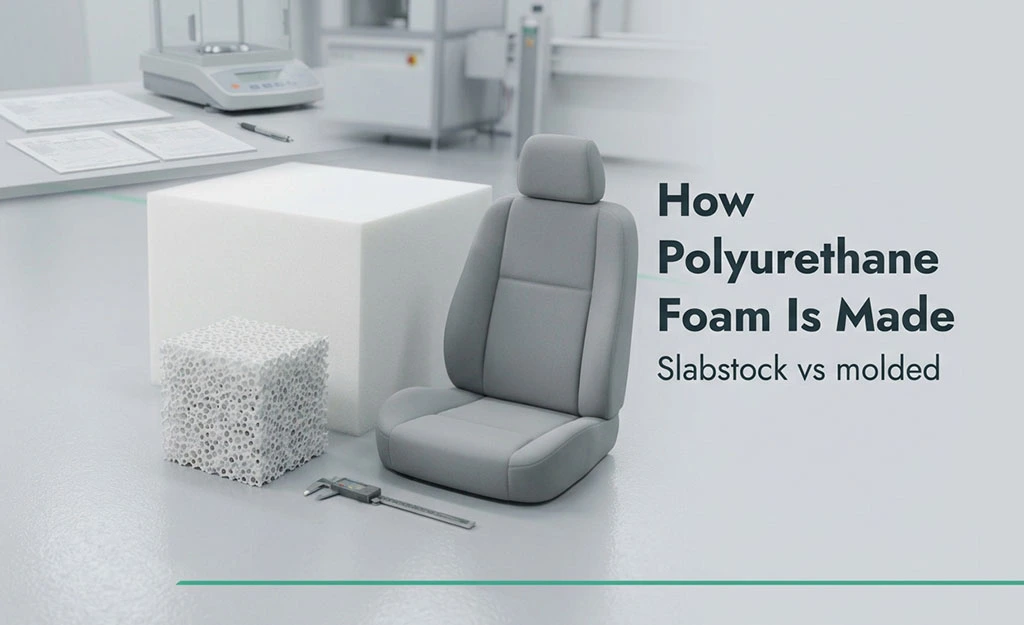
The foam inside a mattress, a car seat or a shipping box is the product of a chemical reaction that’s over in a few minutes. A small mistake in those minutes comes back weeks later as a density or hardness deviation in the lab. This article explains how flexible polyurethane foam is made, how slabstock and molded foam differ, and where quality control fits into production. For the tests that follow production, see our foam testing guide.
What is polyurethane foam made of?
Flexible polyurethane foam forms when two main components react: a polyol and an isocyanate. Slabstock foam mostly uses TDI as the isocyanate, while molded foam typically uses MDI or TDI/MDI blends. Several additives steer the reaction:
- Water: reacts with the isocyanate to release carbon dioxide, which is the gas that expands the foam.
- Catalysts: amine catalysts speed up gas formation, while tin-based catalysts speed up polymer growth, known as gelling.
- Silicone surfactant: stabilizes the cells so the foam rises evenly without collapsing.
- Additives: flame retardants, colorants and fillers, depending on the end use.
Small changes in the ratio of these components shift the density, hardness and resilience of the finished foam.
How the reaction unfolds
Shortly after mixing, the liquid turns pale and creamy; this point is the cream time. The foam then starts to rise as gas is released. Meanwhile the polymer network builds, and at a certain point the foam stops flowing and gels. Once the rise is complete, the foam has reached its final height and a curing phase begins that lasts for hours.
Everything depends on the balance between gas formation and gelling. If the gas runs out before the foam gels, it collapses. If the foam gels too early, cells stay closed and the foam shrinks. That’s why the rise profile, the foam’s height over time, is one of the most telling indicators of a formulation.
Slabstock vs molded foam
| Slabstock foam | Molded foam | |
|---|---|---|
| Process | Mix is poured onto a moving conveyor and rises into a long block | Mix is injected into a closed mold and takes its shape |
| Typical isocyanate | Mostly TDI | MDI or TDI/MDI blends |
| Final shaping | Blocks are cut into sheets or parts | Parts come out of the mold close to final shape |
| Typical products | Mattresses, upholstery sheets, packaging | Car seats, headrests, furniture components |
| Cutting waste | Cutting creates trim waste | Very little trim waste |
Box foaming is a small-scale form of slabstock: the mix is poured into a box in a single batch. It’s used for smaller runs and special formulations.
Common production faults and what they do to the foam
Most production problems leave a measurable trace in the finished foam:
Collapse: the foam settles back partly or fully after rising. It usually comes from an imbalance between gas formation and gelling, for example too little catalyst or surfactant. The result is higher-than-target density and an irregular cell structure.
Shrinkage: when too many cells stay closed, the gas inside contracts as the foam cools and the block pulls inward. The finished foam loses dimensions and drifts in hardness.
Scorch: if the core of a large block overheats from the reaction heat, it discolors and its mechanical properties weaken.
Density variation within a block: the bottom, middle and top of a block can come out at different densities. That’s why test samples should be taken from several points in the block.
Why curing time matters
The rise is over in minutes, but the foam isn’t ready to use at that point. The reaction releases heat, so the core of a large block stays hot for a long time and the chemistry keeps going. Blocks are therefore usually left for at least a day before cutting.
The wait before testing is longer still. Most standards require samples to rest for at least 72 hours after production and then be conditioned at a set temperature and humidity. A sample taken too early doesn’t represent the finished product.
Where quality control fits into production
Quality control doesn’t start once the foam is cut. It happens at three stages:
Formulation trials: new formulas and raw materials are tried at small scale before they reach the production line. Components are mixed in the lab and the cream time and rise behavior are observed. The MK-1060 Foam Lab Mixer is built for these trials, and a full trial is described step by step in hand-mix foam trials.
Monitoring during production: the rise height is tracked. If the profile drifts from target, a problem in the mix shows up before the block is cut. This monitoring is done with the MK-1020 Foam Height Measurement Tester.
Finished product testing: after curing and conditioning, density, hardness, resilience and durability are tested. How those three core numbers relate is covered in foam density vs hardness vs resilience.
Frequently asked questions
Why is water used in foam production?
Water reacts with the isocyanate to produce carbon dioxide, which expands the foam. More water in the formula means more gas and usually a lower density foam.
Is slabstock or molded foam better?
They serve different needs. Slabstock is economical for flat products such as sheets and mattresses, while molding produces complex shapes with little waste. Quality depends more on formulation and process control than on the method itself.
When can new foam be tested?
Most standards call for at least 72 hours after production, followed by conditioning. Shorter times can be used for quick quality checks, but that should be stated in the report.
Why measure the rise profile?
The rise profile reveals a problem in the mix before the block is cut. If the profile drifts from target, the finished foam’s density and hardness are likely to drift as well.