
Foam Sample Preparation and Conditioning: What ASTM D3574 and ISO Require

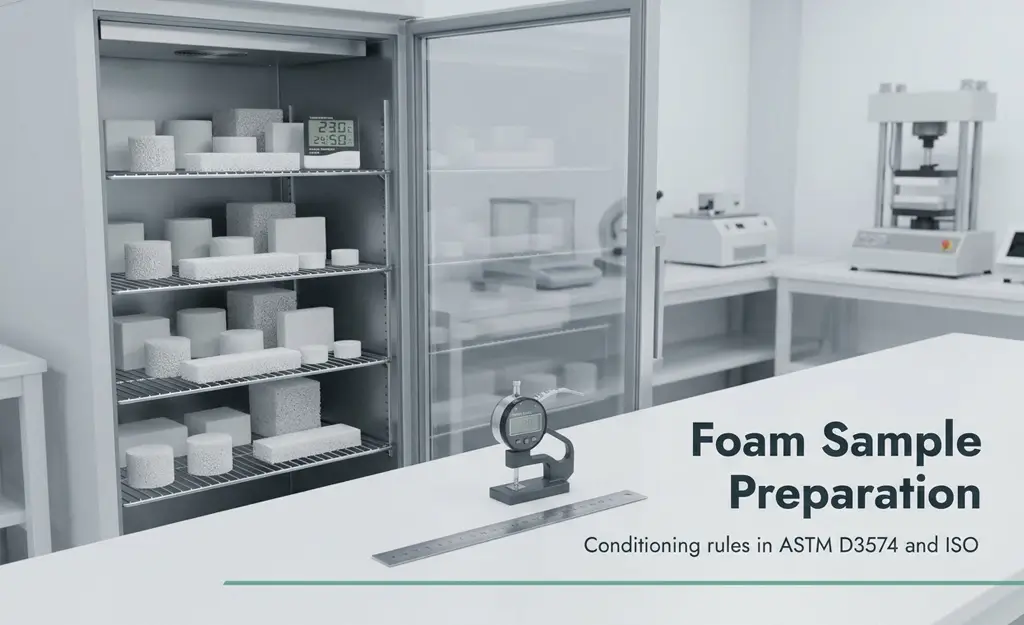
Two specimens cut from the same block can give different hardness and density results if one is tested the day after production and the other a week later. When that happens, the tester is rarely the problem. The difference usually comes from how and when the specimen was prepared. This guide covers foam sample preparation and conditioning: how long to wait after production, how to cut specimens to size, what conditioning atmosphere ISO and ASTM D3574 require, and the mistakes that quietly ruin otherwise good test data. For the full set of foam tests and how they fit together, see our foam testing guide.
Why foam sample preparation decides your test result
Flexible polyurethane foam keeps changing after it leaves the line. The core of a large slabstock block stays hot for hours, the chemical reaction finishes, and the gas inside the cells equalizes with the air. A specimen cut before this settles doesn’t represent the finished product.
Temperature and humidity also shift the reading: the same foam reads firmer in a cold, dry lab than in a warm, humid one. That’s why every foam test standard defines a minimum age after production and a conditioning atmosphere. Skip either, and your result can’t be compared with a supplier’s certificate or another lab’s report.
When to cut: foam age and skin removal
Under ISO standards, the basic rule is that test pieces are cut no sooner than 72 hours after manufacture. ISO 845, the density standard, accepts shorter periods of 48 or 16 hours under specific conditions, provided the report says so. ASTM D3574 recommends testing at least seven days after production for referee tests, where two parties need to agree on a disputed result.
Shorter waits are fine for in-process checks, but those numbers shouldn’t go on a customer report.
Skin matters too. Molded parts and the outer surfaces of slabstock blocks have a denser skin and compacted layers. If you’re measuring core properties, remove them. For molded parts, ASTM D3574 asks for specimens taken at least 10 mm in from the mold surface. If you test a full part with its skin on, note it in the report, because the skin raises both density and hardness.
Cutting foam test specimens to the right size
Each test defines its own specimen, so plan your cuts after the test list is final. Typical test pieces for the most common methods:
| Property | Standard | Typical test piece |
|---|---|---|
| Density | ISO 845 / ASTM D3574 Test A | At least 100 cm³ volume, at least 5 pieces |
| Hardness (indentation) | ISO 2439 / ASTM D3574 Test B1 | 380 × 380 × 50 mm (ISO); at least 380 × 380 × 100 mm (ASTM) |
| Resilience (ball rebound) | ISO 8307 / ASTM D3574 Test H | At least 100 × 100 × 50 mm |
| Tensile strength and elongation | ISO 1798 / ASTM D3574 Test E | Dumbbell cut with a die |
| Compression set | ISO 1856 / ASTM D3574 Test D | 50 × 50 × 25 mm, 5 pieces |
| Dynamic fatigue | ISO 3385 | 380 × 380 × 50 mm |
Using a non-standard size isn’t forbidden, but the report has to state it. Thickness is the critical one: indentation hardness measured on 50 mm and 100 mm specimens can’t be compared. For density specifically, the volume and piece count requirements are explained in our article on foam density test standards.
Measuring dimensions (ISO 1923)
ISO 1923 covers how linear dimensions of cellular materials are measured. The key point is contact pressure. A caliper squeezed onto soft foam compresses it and underreports thickness, which flows straight into density and compression set calculations. Use a gauge with a defined, low contact pressure and take readings at several points across the specimen.
Foam conditioning: temperature, humidity and time
Once cut, specimens are conditioned in a controlled atmosphere before testing. ISO methods typically use 23 ± 2 °C and 50% relative humidity. ISO 1856 also allows a tropical alternative of 27 ± 2 °C and 65% relative humidity. ASTM D3574 uses 23 ± 2 °C and 50% relative humidity as well. The allowed humidity tolerance varies by standard, usually between ±5 and ±10 points, so check the method you’re reporting against.
Minimum conditioning time differs: ISO 845 asks for at least 16 hours, while ASTM D3574 asks for at least 12 hours. Specimens should sit unloaded and unstacked, with every face exposed to the air, and be tested in the same atmosphere. Differences like these are one reason ISO and ASTM results don’t always line up, as we explain in ASTM D3574 vs ISO.
Lab-made samples: hand mixing vs a laboratory mixer
In formulation work, specimens often come from a small foam made in the lab rather than from a production block. The same aging and conditioning rules apply. However, there’s an extra source of scatter: the mixing itself. If mixing speed and time vary from trial to trial, careful specimen preparation won’t save the data, because the foams weren’t made the same way.
A mixer that holds speed and time constant, such as the MK-1060 foam lab mixer, makes sure that differences between trials come from the formulation, not the operator’s hand. The step-by-step method for a cup foam trial is in our article on hand-mix foam trials.
Common foam sample preparation mistakes
Most bad foam data traces back to a handful of preparation errors:
- Cutting from a warm block. The cure isn’t complete, so density and hardness both read wrong.
- Crushing cells during cutting. A dull blade or the wrong tool tears and compacts the edges. ASTM D3574 recommends a band knife or band saw for compression set specimens.
- Not recording the position in the block. Slabstock density can vary between the bottom, middle and top of a block. Without a position record, you can’t tell whether a deviation came from the process or the sampling.
- Transporting specimens compressed. Pieces pushed into a bag or stacked under weight don’t fully recover before testing. That affects every test that depends on specimen thickness, including the foam resilience ball rebound test.
- Conditioning in one room, testing in another. A temperature change of a few degrees between conditioning and testing is enough to shift hardness.
FAQ
How long should foam be conditioned before testing?
ISO 845 requires at least 16 hours and ASTM D3574 at least 12 hours, both at 23 ± 2 °C and about 50% relative humidity. This comes after the minimum age after production, which is 72 hours under ISO in most cases.
Do you remove the skin before testing foam?
For core density and most mechanical tests, yes. Skin and compacted layers raise the result. If you’re testing a complete molded part with its skin on, that’s acceptable, but it has to be stated in the report.
What size is a foam test specimen?
It depends on the test. Indentation hardness to ISO 2439 uses 380 × 380 × 50 mm, compression set to ISO 1856 uses 50 × 50 × 25 mm, and density to ISO 845 needs at least 100 cm³ per piece.